


Imagine this: Investing time and money in driving visitors to your website, only for their details to sit idle in a database with no follow-up, no segmentation, and no automation. That missed opportunity can cost more than just a single lead; it can affect recurring revenue and customer trust.
Let me tell you that every day, thousands of businesses lose valuable leads simply because their contact forms aren’t synced to a powerful marketing system.
If you are a WordPress user relying on Contact Form 7 for capturing inquiries, signups, or demo requests, you are already using one of the most trusted plugins in the world.
But here is the challenge: how do you ensure those leads instantly flow into ActiveCampaign so you can automate welcome emails, assign tags, and trigger personalized campaigns?
This guide is designed for entrepreneurs, marketers, developers, and website owners who want to take their lead management to a professional level.
From plugins to API webhooks, from mapping fields to building automations, every section in this guide aims to help you integrate Contact Form 7 with ActiveCampaign in the most effective, compliant, and future-ready way possible.
So, let’s get started!
➡️Need only the steps without the details? We have drafted a dedicated microblog for readers who prefer a quick setup tutorial. It walks you through connecting Contact Form 7 with ActiveCampaign in minutes.
Prerequisites For WordPress To ActiveCampaign Integration
Before connecting Contact Form 7 to ActiveCampaign, it is crucial to ensure your setup meets the necessary conditions for smooth integration. Skipping these steps often leads to failed syncs, missing data, or compliance risks.
Here is what you need in place:
- WordPress with Contact Form 7 installed: The plugin should be updated and active, serving as the base for your lead capture.
- Admin access: Full administrator rights to both WordPress and your ActiveCampaign account are required to authorize the connection and configure the advanced features.
- API key and API URL: These credentials can be found in your ActiveCampaign account under Settings>Developer. Copy them carefully, as they are needed for authorization.
- Data compliance readiness: Follow GDPR and CCPA guidelines by adding consent checkboxes in your forms. It ensures subscribers willingly join your list and protects you from regulatory issues.
By confirming these elements, you can create a rock-solid technical and ethical foundation for the integration process.
Main Message: A successful WordPress to ActiveCampaign integration starts with a proper setup. Updated plugins, admin access, API credentials, and compliance practices ensure reliable syncing and build trust with every new subscriber.
ActiveCampaign Code Webhook Integrations Explained
ActiveCampaign allows developers to build custom webhook integrations using its API. Instead of relying only on plugins, you can send Contact Form 7 submissions directly to ActiveCampaign using webhook code. This approach gives you full control over field mapping, tagging, and automation triggers.
Best Plugins To Connect Contact Form 7 With ActiveCampaign
If you are a WordPress user running Contact Form 7, the simplest way to connect your form with ActiveCampaign is by using a plugin. Plugins eliminate the need for coding and handle API authentication smoothly. They allow you to configure field mapping, tags, and automation directly inside your dashboard.
The ideal plugin ensures that your leads are synced quickly and securely without technical headaches.
Here are the most reliable plugin choices available:
- Contact Form to API: An effective solution designed for seamless integration. It enables advanced field mapping, flexible tag assignments, multiple API endpoints, and compliance features, such as GDPR and CCPA support. It is suitable for businesses that want professional-grade syncing and automation without complexity.
- Bit Integrations: This plugin supports many third-party applications and offers no-code automation. It is user-friendly. However, advanced mapping and configuration often require additional steps, which may not serve every business case.
- Advanced Form Integration: It is suitable for basic integration needs and offers a straightforward setup. Though it is helpful for simple connections, it can feel restrictive when handling custom fields or advanced automation scenarios.
Evaluate long-term support, feature scalability, and data security when comparing plugins. A plugin like Contact Form to API stands out by offering both simplicity and the flexibility needed to manage complex ActiveCampaign workflows.
Quick Recap: Selecting the best plugin to connect Contact Form 7 with ActiveCampaign depends on reliability, features, and compliance. Contact Form to API offers robust mapping, flexible automation, and secure syncing, making it a dependable option for WordPress users.
Contact Form 7 API Integration With ActiveCampaign (Webhook Tutorial)
Not every WordPress user prefers plugins. Some teams need tighter control than plugins allow. For such cases, ActiveCampaign code webhook integrations provide a direct path between Contact Form 7 and ActiveCampaign using the API itself.
You can also integrate Contact Form 7 with ActiveCampaign through a webhook or direct API method. It is ideal for those who want more control or have specific customization needs.
Though it requires more setup effort than using a plugin, it can be an excellent choice for developers or teams with technical expertise.
Here are the steps to set up a webhook integration:
- Open Contact Form 7 Settings: Select the form you want to integrate and go to its settings panel.
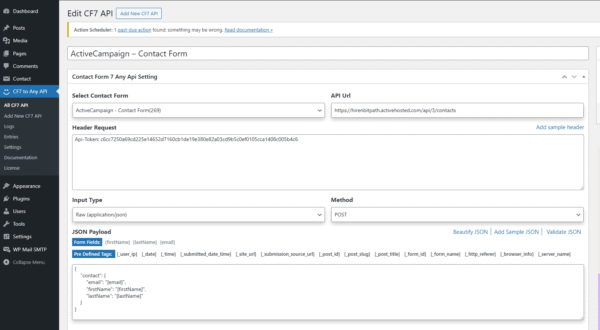
- Add Webhook or API Endpoint: Insert the ActiveCampaign API endpoint where form data will be sent.
- Include Required Headers and Keys: Add your ActiveCampaign API URL and API key to authenticate the request.
- Configure Field Mapping in Code: Verify each form field with the correct ActiveCampaign field using webhook parameters.
- Save and Test your Integration: Submit a form entry and confirm the data appears in ActiveCampaign.
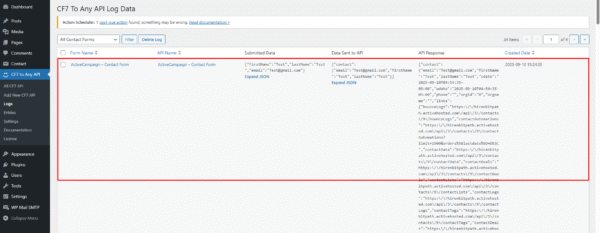
Webhooks offer flexibility, but they also come with risks if inaccurately configured. Hence, always test thoroughly and document your setup for ongoing maintenance.
What This Means For You: Using a webhook or API integration with Contact Form 7 and ActiveCampaign gives more control than plugins. However, it requires careful setup, authentication, and testing to ensure data is transferred securely and precisely.
Mapping Contact Form 7 Fields To ActiveCampaign
Accurate field mapping ensures that every detail submitted through your Contact Form 7 form is stored correctly in ActiveCampaign. Without proper mapping, you risk losing pivotal data or creating incomplete contact records.
By aligning fields, you create consistency across your marketing workflows and unlock more precise segmentation.
Here is how to map fields effectively:
- Basic Fields: Connect the form’s Name field to First Name or Full Name. And link the Email field directly to ActiveCampaign’s primary Email field.
- Phone and Company Details: Assign the Phone field to the dedicated Phone field and map any Company field to a custom field in ActiveCampaign.
- Custom Fields: Create additional custom fields in ActiveCampaign, such as Source, Campaign, or Referral, then map them to form inputs.
- Tags for Segmentation: Apply tags like “website-contact” or “ebook-download” to categorize and segment leads automatically.
- Avoid Errors: Ensure field names and types match correctly; otherwise, data may fail to sync or create mismatched records.
Well-planned field mapping makes lead data cleaner, easier to segment, and more actionable for your campaigns.
Must-Know Insight: Mapping Contact Form 7 fields to ActiveCampaign is crucial for accurate lead management. Proper alignment of basic, custom, and tagged fields ensures consistent data, superior segmentation, and smooth automation inside ActiveCampaign.

Assigning Lists, Tags, And Opt-In Settings
Once your fields are mapped, the next step is determining where each new subscriber should go inside ActiveCampaign. Assigning lists, applying tags, and configuring opt-in preferences are critical for building organized and compliant contact records.
When done correctly, this process improves segmentation and ensures that your automations reach the ideal audience.
Here is how to configure these settings:
- Assign Lists: Add new contacts to the appropriate list, such as “Newsletter,” “Event Registrations,” or “Leads.”
- Apply Default Tags: Use tags such as “website-form” or “product-interest” to categorize subscribers based on their form type or intent.
- Set Opt-in Preferences: Decide whether you want single opt-in for simplicity or double opt-in for higher security and engagement quality.
- Use Conditional Logic: Configure rules to send contacts to different lists or apply tags based on the way they answer form questions.
By carefully managing lists, tags, and opt-in settings, you build a clutter-free database that supports more relevant campaigns.
The Bottom Line: Assigning lists, tags, and opt-in preferences in ActiveCampaign ensures subscribers are organized, segmented, and compliant. It makes it more effortless to run targeted campaigns and maintain a healthy, permission-based contact database.
Testing And Troubleshooting Contact Form 7 To ActiveCampaign Integration
After setting up your integration, testing is the only way to ensure data flows correctly from Contact Form 7 to ActiveCampaign. A successful test confirms that fields are mapped appropriately, subscribers land in the ideal list, and automations are triggered as intended.
Without testing, you risk errors that frustrate leads and create confusion in your campaigns.
Here are the vital steps and troubleshooting tips:
- Submit a Test Form: Enter sample details in your Contact Form 7 form and check if they appear in ActiveCampaign.
- Verify API Credentials: If data does not sync, confirm that your API key and URL are entered appropriately in the plugin or webhook.
- Check Required Fields: Confirm mandatory fields, such as email, are filled in; missing data often causes failed submissions.
- Resolve Field Mismatches: Ensure form field names match the appropriate ActiveCampaign fields to mitigate errors.
- Handle Duplicates: Prevent duplicate records by enabling the option to update existing contacts instead of creating new ones.
- Confirm Opt-in Settings: If double opt-in is enabled, confirm that the verification email is being sent and accepted.
Systematic testing combined with quick troubleshooting ensures a reliable and error-free integration.
Knowledge Drop: Testing and troubleshooting your Contact Form 7 ActiveCampaign integration helps eliminate data errors. By verifying API keys, field mappings, opt-ins, and duplicates, you ensure accurate syncing and smooth campaign performance every time.
Setting Up Contact Form 7 With ActiveCampaign Marketing Automation Workflows
Once your integration is tested, the tangible value comes from automation. That is where a proper email ActiveCampaign integration turns form submissions into something operational rather than reactive. You can move beyond simply collecting leads and begin nurturing them with personalized messages and timely follow-ups.
Automations save time, improve consistency, and foster meaningful relationships with your audience.
Here are some essential workflows to create:
- Welcome Series: Send a warm introduction to new subscribers, share handy downloadable resources, and highlight your brand’s value.
- Lead Nurture Campaigns: Using tags and custom fields to send personalized content that resonates with each subscriber’s interest or stage in the buying journey.
- Sales notifications: Automatically notify your sales team when a high-value lead completes a form, ensuring fast follow-up.
- Re-engagement Campaigns: Target inactive contacts with captivating offers or surveys to bring them back into your funnel.
You can turn simple form submissions into meaningful customer journeys by aligning automations with your business goals.
In a Nutshell: ActiveCampaign workflows built from Contact Form 7 submissions enable you to send welcome emails, nurture leads, notify sales, and re-engage inactive contacts. It transforms basic forms into a system for continuous customer growth.

Advanced ActiveCampaign Integration Strategies For WordPress
Beyond basic form syncing, advanced strategies allow you to collect valuable data and design more powerful campaigns. These methods help you capture context, fine-tune targeting, and achieve in-depth personalization inside ActiveCampaign.
Marketers who invest in next-level setups often see higher engagement and stronger lead conversion.
Here are some proven-effective strategies to consider:
- Hidden Fields: Capture UTM parameters, referral sources, or landing page URLs without requiring the user to input extra details.
- Custom Segmentation: Map additional custom fields such as product interest, lead source, or campaign type to group your contacts systematically.
- Conditional Routing: Send leads to different lists or apply specific tags depending on how users answer key questions in the form.
- Direct API Calls: Developers can bypass plugins and post data straight into ActiveCampaign for complete control and customization.
Applying these strategies gives you the flexibility to scale campaigns and adapt to evolving marketing requirements.
Smart Summary: Advanced integration strategies for WordPress and ActiveCampaign include hidden fields, conditional routing, custom segmentation, and direct API calls. All this enhances data quality, personalization, and long-term campaign performance.
Security, Privacy, And Compliance Essentials
Collecting subscriber information comes with responsibilities. Whether your audience is in the United States, Europe, or anywhere else, data protection laws apply to every form submission you capture. ActiveCampaign offers helpful tools.
However, you must configure Contact Form 7 properly to ensure adherence and cultivate trust.
Here are salient security and compliance practices:
✅Consent Checkboxes: Always include an unambiguous marketing permission checkbox in your Contact Form 7 forms to comply with GDPR and CCPA.
✅Unsubscribe Management: Validate that unsubscribe links in ActiveCampaign emails work correctly. They should enable contacts to leave lists hassle-free.
✅Data Minimization: Collect only the data you actually need. Storing excessive or irrelevant information increases risk without refining campaigns.
✅Retention Policies: Periodically audit and clean your contact database to adhere to data retention rules and improve list health.
By combining transparent form design with ActiveCampaign’s compliance settings, you protect your business and your subscribers.
Essential Insight: Strong compliance practices in Contact Form 7 and ActiveCampaign include consent checkboxes, unsubscribe management, minimal data collection, and retention audits. All this ensures privacy, builds trust, and guards your brand reputation.
Best Practices To Maximize Contact Form 7 + ActiveCampaign Results
Integrating Contact Form 7 with ActiveCampaign is only the beginning. You need to fine-tune your forms and campaigns constantly to yield favorable results. A thoughtful approach ensures higher conversion rates, superior engagement, and more meaningful subscriber relationships.
Here are proven best practices to follow:
- Optimize Form Design: Keep forms short and user-friendly to encourage more submissions while still collecting necessary details.
- Segment Effectively: Use tags and custom fields to group contacts by interest, behavior, or lifecycle stage.
- Automate Follow-ups: Send timely emails such as confirmations, reminders, or personalized offers to keep subscribers engaged.
- Audit Regularly: Test your integration and review contact records to ensure data accuracy and uniform performance.
Applying these practices transforms simple form submissions into well-managed, long-term customer relationships supported by precise data and targeted communication.
What You Should Know: Regularly optimizing forms, segmenting contacts, automating follow-ups, and auditing data ensures your Contact Form 7 and ActiveCampaign integration delivers higher conversions, stronger engagement, and long-term marketing success.
You Can Refer to our blog – Contact Form 7 Third Party Integration Guide: Connect Anywhere
Real-World Use Cases Of Contact Form 7 To ActiveCampaign Integration
The real power of integrating Contact Form 7 with ActiveCampaign is best witnessed in real-world scenarios. By converting simple form submissions into automated workflows, businesses can boost efficiency and deliver more meaningful customer experiences.
Here are some practical examples:
Use Case 1: Newsletter Signups
When a visitor subscribes to your newsletter through Contact Form 7, ActiveCampaign can instantly add them to your mailing list.
➡️For example, a local coffee shop can welcome new subscribers with a personalized “Thank You” email, followed by a series introducing their seasonal blends and exclusive offers.
Use Case 2: Ebook Downloads
Offering ebooks as lead magnets is common. With ActiveCampaign, you can automatically tag anyone who downloads your ebook.
➡️For instance, a digital marketing agency can deliver the ebook instantly. After that, launch a nurture sequence sharing case studies, tips, and client success stories.
Use Case 3: Event Registrations
Events need structured communication. When someone registers using your Contact Form 7 form, ActiveCampaign can schedule reminder emails.
➡️For example, a fitness studio can remind attendees of an upcoming workshop and follow up with a thank-you note and a discount on future sessions.
Use Case 4: Support or Contact Requests
Customer inquiries require fast responses. By integrating Contact Form 7 with ActiveCampaign, submissions can trigger support notifications.
➡️For instance, a SaaS company can automatically route inquiries into its support pipeline, ensuring the team follows up promptly while keeping a record in the CRM.
These use cases demonstrate how Contact Form 7 and ActiveCampaign together transform static form submissions into automated experiences that drive engagement, loyalty, and growth.
Key Takeaway: From newsletters and ebooks to events and support, every use case demonstrates that integrating Contact Form 7 with ActiveCampaign adds efficiency, personalization, and value. It turns simple submissions into powerful customer journeys.

Conclusion
Integrating Contact Form 7 with ActiveCampaign is more than a technical process; it is about building a reliable bridge between your website and your marketing system, where every captured lead has purpose and direction.
From prerequisites and plugins to API webhooks and advanced workflows, this guide has equipped you with a roadmap. You can now connect, segment, and automate with clarity rather than relying on guesswork.
The true advantage begins when you put these insights into practice. Each mapped field, every assigned tag, and each automation you create moves you closer to a marketing system that is efficient, scalable, and designed for growth.
Leads no longer slip away unnoticed; they become opportunities for nurturing and long-term success.
A solution like Contact Form to any API can help make this integration straightforward and reliable. With advanced mapping, compliance features, and automation support, it transforms your setup into a professional, secure, and future-ready system.
Start today, and turn every form submission into a measurable step forward for your business.
Frequently Asked Questions
How do ActiveCampaign webhook integrations work?
ActiveCampaign webhook integrations send contact data in real time when a specific event occurs, such as a new form submission. The webhook automatically transfers data to a defined URL, allowing seamless syncing between Contact Form 7 and ActiveCampaign without manual updates.
What is a webhook in ActiveCampaign Integration?
A webhook in ActiveCampaign sends real-time data from your account to an external application whenever a specific event occurs (like a new contact, tag added, deal created, or form submission). It allows instant automation beyond the platform.
Can I use custom code for ActiveCampaign integration?
Yes, you can use custom API or webhook code to connect Contact Form 7 with ActiveCampaign. This method gives developers more control over field mapping, tagging, and automation compared to standard plugin-based integrations.
What is the difference between API and webhook integration in ActiveCampaign?
API integration sends data to ActiveCampaign manually through coded requests, while webhook integration automatically sends data when an event is triggered. API pushes data to ActiveCampaign, whereas webhooks send data in real time based on events.
Can I Integrate CF7 With ActiveCampaign Without Plugins?
Yes. You can integrate Contact Form 7 with ActiveCampaign using webhooks or direct API calls. Though this method offers total control, it demands technical proficiency. You need to configure endpoints, authentication, and field mappings manually.
Can I test ActiveCampaign webhook integrations in a demo or staging environment?
Most teams test webhook integrations using a separate test account or isolated tags and lists. They validate payloads and authenticate before sending data to production endpoints.
Should I Use Single or Double Opt-In?
Single opt-in adds subscribers immediately. However, double opt-in requires email confirmation, and it is recommended for compliance, cleaner lists, and more favorable engagement. It ensures only genuinely interested contacts join your ActiveCampaign lists.
Can I Send File Uploads From Contact Form 7 To ActiveCampaign?
Direct file uploads are not supported in ActiveCampaign lists. However, you can store files in WordPress or cloud storage and include links to those files within ActiveCampaign custom fields or automated emails.
How Can I Connect Multiple Forms To Different ActiveCampaign Lists or Tags?
Most plugins let you connect each Contact Form 7 form to unique lists or tags in ActiveCampaign. It makes it easy to filter contacts by purpose, such as newsletter signups, support requests, or event registrations.
Can I Test My Contact Form 7 ActiveCampaign Integration Before Going Live?
Yes. Always submit test entries to confirm field mapping, tags, and automations are working as intended. Testing helps identify sync errors early and ensures your campaigns launch without missing or incorrect subscriber data.
Is It Possible To Add Hidden Fields like UTM Parameters or Referral Sources?
Yes. You can create hidden fields in Contact Form 7 and map them to ActiveCampaign custom fields. It enables you to track campaign performance, measure lead sources, and personalize follow-ups. You don’t need to ask users for additional information.
What Should I Do If My Contact Form 7 Leads Are Not Syncing To ActiveCampaign?
First, check your API key and URL. Then review required fields (like Email), confirm field mappings, and recheck opt-in settings. If issues persist, retest your plugin or webhook configuration to resolve syncing problems.


