


Introduction: Why Spam-Free Form Automation Matters in 2026
Spam has become the quiet tax on every CF7 workflow.
Most days, the inbox looks fine. Then one bad submission slips through and reminds you how fragile automation can be. A single junk payload can skew CRM scoring, trigger the wrong workflow, or distort analytics that teams rely on for decisions.
If your CF7 inbox sometimes feels like a bot festival, you are not alone.
The real problem is not just spam at the form level. It is what happens after submission. Once bad data enters an automation chain, every connected system treats it as real. Spam-free form automation is no longer about cleanup. It is about protecting data accuracy, workflow reliability, and trust across every integration.
Modern WordPress anti-spam integration focuses less on visible blockers and more on ensuring that only clean, validated data ever reaches your APIs.
Why CF7 Users Need to Move Beyond Traditional reCAPTCHA
Most teams already feel the slowdown when visible checks interrupt a form. A user arrives ready to submit and hits an unexpected barrier. The shift in momentum is immediate.
Developers see the deeper problem. Bots adapt faster than these surface checks, yet legitimate users still get flagged.
You have probably seen the fallout yourself: a valid lead submits the form, the visible check misfires, and your CRM never receives the record. The automation path remains silent because the form stopped the wrong person.
That is why reCAPTCHA alternative methods are gaining traction. WordPress spam prevention is shifting toward defenses that stay hidden, maintain flow, and filter noise without disrupting genuine users.
Security now carries a simple expectation. It should stay quiet and not dictate how people interact with the form.
Modern WordPress Anti-Spam Techniques That Work With Contact Form 7
Effective CF7 protection works in layers, not pop-ups.
Instead of relying on a single visible gate, modern setups combine lightweight checks that surface intent without punishing interaction:
- Honeypot fields catch the dumb bots that fill every input.
- Time-based validation rejects submissions finished at lightning speed.
- Keyword and pattern checks flag common junk that never passes business rules.
- Behavior-driven filtering analyses typing rhythm and mouse patterns to distinguish humans from scripts. It reads intent, not just inputs.
- API-level email or phone verification confirms identity before the payload moves downstream. A verified contact is a high-confidence lead.
Industry coverage consistently points to this layered approach. Publications like TechRadar have highlighted how WordPress sites face millions of automated attacks in short periods, emphasizing how fast bot tactics evolve and why surface-level defenses fall behind.
Once the form itself is protected, the next weak point becomes obvious: the automation layer.

The Real Problem: Spam That Slips Into Your API Workflows
Spam that reaches your API is no longer just noise. It is corrupted data.
A bot submission triggers workflows built for real users. CRMs accept it. Lead scoring processes it. Segmentation reacts as if it were legitimate. One bad payload can ripple across multiple systems without raising alarms.
This is where traditional form protection quietly fails. Front-end checks stop some bots, but anything that reaches the endpoint is trusted by default.
For teams relying on automation, spam inside API workflows is more dangerous than spam in email inboxes. It distorts insights, erodes trust in dashboards, and forces teams to second-guess their data.
The fix does not live at the UI. It lives at the API layer.
Why API Based Form Submission Is the Strongest Anti-Spam Layer for CF7
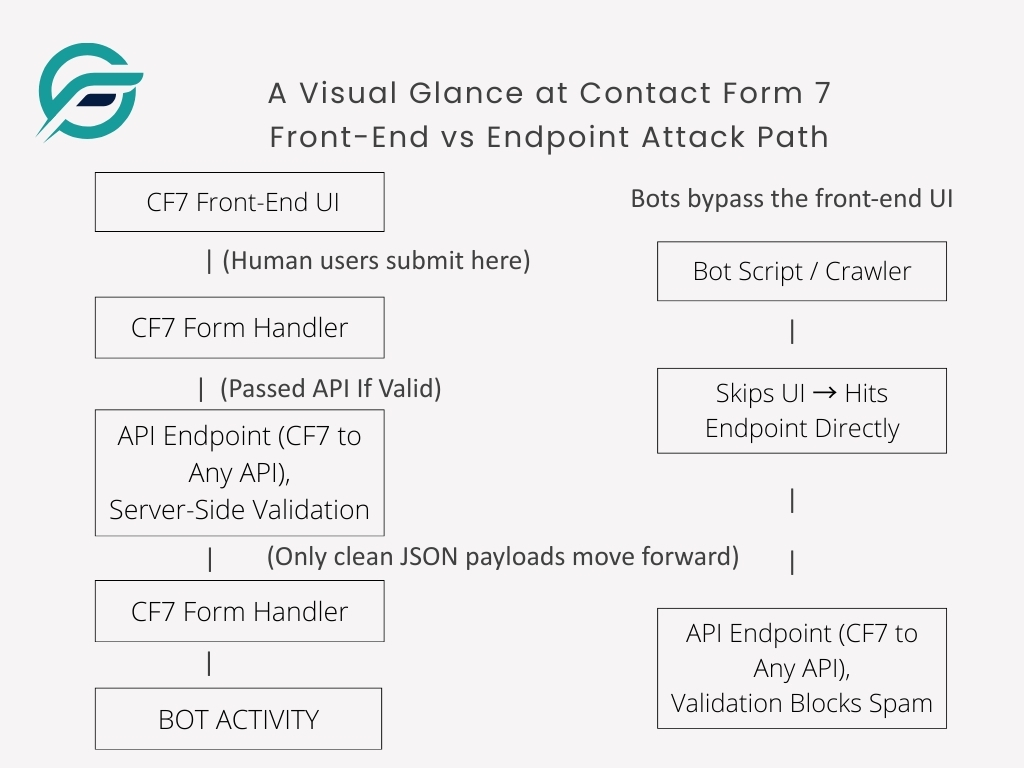
Developers already know the blind spot. Bots skip the front end entirely and hit the endpoint because browser checks don’t matter there.
API-based form submission shifts the control point. Every request must meet structured rules before anything moves downstream:
- Bots can fake a checkbox, but they cannot assemble a clean JSON payload that matches your rules.
- Structured data exposes intent, and server-side validation reinforces it.
- Format, logic, and context are checked early, which turns uncertainty into precision.
Industry reporting points in the same direction. Make, OOPSpam, and sources like Guardian Digital all mention the shift toward API-level filtering. In contrast, external data reveals WordPress sites face millions of automated attack attempts in a matter of days. It emphasizes how real the threat landscape has become.
Contact Form 7 to Any API applies this principle directly to CF7. Submissions are validated, structured, and sanitized before they ever reach external systems. No new form builder. No external anti-spam service. Just a predictable, cleaner automation path.
Privacy First Spam Prevention for WordPress and CF7
Developers are moving away from heavy anti-spam widgets for a simple reason: every external checkpoint carries a cost. It slows the form, exposes data, and adds dependencies no one wants to maintain.
The shift is toward methods that remain local and keep the validation chain inside WordPress. Tools like ALTCHA illustrate this broader trend. They reveal how privacy-friendly checks can work without sending user data beyond the website.
API-based validation fits naturally into this model. Data stays inside WordPress. Validation logic stays under your control. No external rules determine whether a submission is “allowed.”
With Contact Form 7 to Any API, the data path remains direct and private. Protection happens quietly, without exposing users or slowing forms.

Seamless Automation: Secure CF7 Forms That Still Convert
Security does not have to hurt conversions.
Traditional anti-spam methods add friction at the worst moment. Users hesitate. Drop-off begins. Bots adapt anyway.
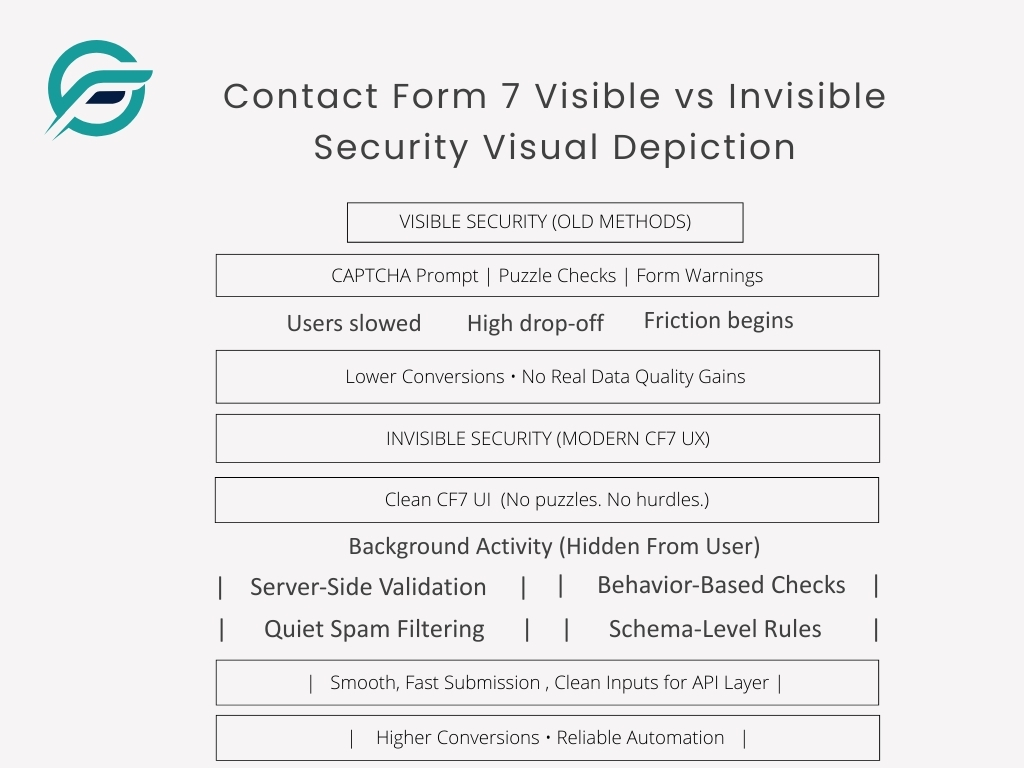
Modern WordPress anti-spam integration takes a different path:
- Security runs in the background.
- Validation happens server-side.
- Behavior checks stay invisible.
Hence, the form looks simple because the heavy lifting happens elsewhere.
That clarity pays off when you automate. When users experience a smooth submission and automation receives clean data, both sides win. Conversion rates stay healthy. Workflows remain reliable.
This balance is the goal. Invisible protection for users, uncompromising validation for systems.
How Contact Form to Any API Secures and Automates CF7 Forms
This is where CF7AA becomes the stabilizing layer.
Contact Form 7 to Any API enhances CF7 without replacing it. It focuses on what developers care about most: precision and control.
Key protections include:
- Server-side validation catches malformed or incomplete data before it moves.
- Schema-aligned payloads ensure every field aligns with the target CRM or platform.
- Sanitization cuts noise at the source, so nothing messy travels forward.
- Duplicate prevention stops automation loops triggered by repeated entries.
- Required field checks confirm that every critical value is present and correct.
- Email or phone verification adds an extra layer of confidence without slowing down users.
- Clear API logs show exactly what was sent, what was returned, and why something failed.
These controls make a real difference because bots cannot produce a clean, rule-aligned JSON payload.
Contact Form 7 to Any API does all of this without replacing Contact Form 7. It turns CF7 into a stable, automation-ready layer that delivers spam-free form automation and consistent, reliable API-based form submission.

Practical Checklist: Build a Spam-Free, API Ready CF7 Form
Use this checklist as a repeatable workflow:
- Validate critical fields before creating the API payload
- Add honeypots or behavior checks for obvious bots
- Apply keyword and pattern filters where needed
- Verify emails or phone numbers through APIs
- Sanitize all text inputs
- Map fields carefully to match target schemas
- Block duplicate submissions
- Enable server-side validation for sensitive fields
- Use API logs as the source of truth
When form, validation, and API work as one path, spam struggles to survive.
Developer Friendly FAQs for Spam Free CF7 Automation
How do bots bypass Contact Form 7 security?
They skip the browser entirely and go straight to the endpoint. Front-end checks never run, which is why server-side validation and API-based filtering become the real gatekeepers.
What is the best reCAPTCHA alternative for CF7?
Developers incline toward frictionless, privacy-friendly checks that stay invisible. These options avoid puzzles, reduce abandonment, and align with modern expectations without relying on external data collection.
Does anti-spam filtering slow down CF7 submissions?
Not when the checks run server-side. Validation completes quietly behind the scenes. Hence, the user experiences a hassle-free, fast submission flow.
Can API validation work without any visual anti-spam widget?
Yes. Most modern methods operate in the background. No prompts, no images, no obstacles for legitimate users.
How does CF7AA help reduce spam inside CRM workflows?
Structured payloads, clear field rules, and actual validation keep noise out of the automation chain. The CRM receives clean, trusted data instead of guesswork.
Is API-based filtering enough on its own?
In most cases, yes. Pairing it with basic CF7 checks creates a stronger, more predictable defense without adding complexity.


